This week we discussed themes of existentialism and how the inherent meaninglessness of life defined by this school of thought plays out in noir films. According to Robert G. Porfirio, existentialism “is an outlook which begins with a disoriented individual facing a confused world he cannot accept. It places its emphasis on man’s contingency in a world where there are no transcendental values or moral absolutes, a world devoid of any meaning but the one he creates” (81). Porfirio translates this complex definition into the world of film noir by defining and explaining existential film noir motifs such as the non-heroic hero, the man under sentence of death, and the burden and freedom of existential choice. These motifs show up in a scene in Double Indemnity, a salacious noir thriller about murder, lust, and insurance.
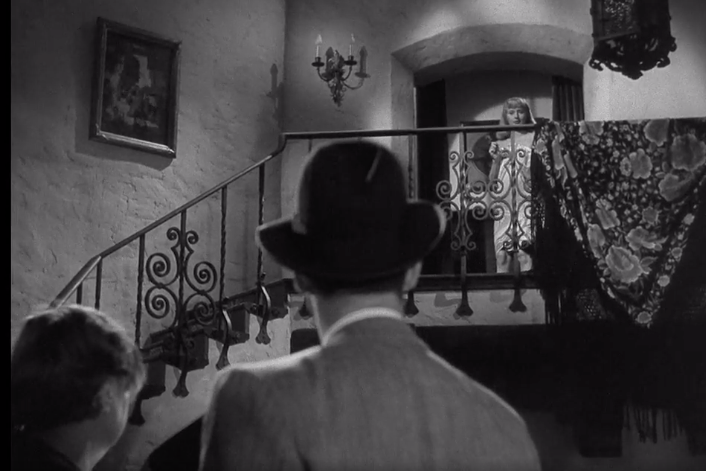
The scene begins when the protagonist Walter Neff enters the home of his client, a Mr. Dietrichson, in an attempt to get him renew his insurance. Instead of Mr. Dietrichson he encounters his wife, Phyllis Dietrichson, emerging from the upstairs hallway glowing from her recent sunbath and the spotlight shining down on her from overhead. It is here we encounter the first of our existential motifs: the unheroic hero.
The way the Phyllis is introduced frames her as powerful and Walter as vulnerable, a staple characteristic of the unheroic noir hero. In the image above, the camera views Phyllis from a low angle and conversely views Walter from a high angle (seen below). In cinematic language, this makes Phyllis come off as in control of the situation and Walter come off as her willing subject–which, of course, he most certainly is.

Walter Neff is a horndog. We know this not only from the way he practically drools over the sight of Phyllis in a towel, but from what he narrates to us as she descends the steps after dressing. Walter’s voice over tell us, “I was thinking about that dame upstairs and the way she had looked at me, and I wanted to see her again, close. Without that silly staircase in-between us” (0:09:25-9:32). The obvious lust Walter displays does more for his character than just show us how…lustful is. While this characteristic wasn’t mentioned in Porfirio’s chapter, I would say it goes towards framing him as a non-heroic or at least non traditional hero.
Another motif present here and immediately prior in the film is the man under sentence of death. The scene right before this features a dying Walter confessing the film’s story over the phone. His narration is what he’s actually saying to someone named Keys. On this narration and the sentence of the death, Porfirio writes, “It is almost as if the narrator takes a perverse pleasure in relating to the events leading up to his current crisis…” (89). He then goes on to cite Double Indemnity as a direct example of this. Walter certainly certainly seems pleased by talking about Phyllis, but he almost seems to love telling his story just for the telling. In his narration he languishes on the details of his surroundings, taking the time to discuss the venetian blinds and red goldfish in the living room. Walter embodies this existential motif thoroughly, just as he does the motif of existential choice.
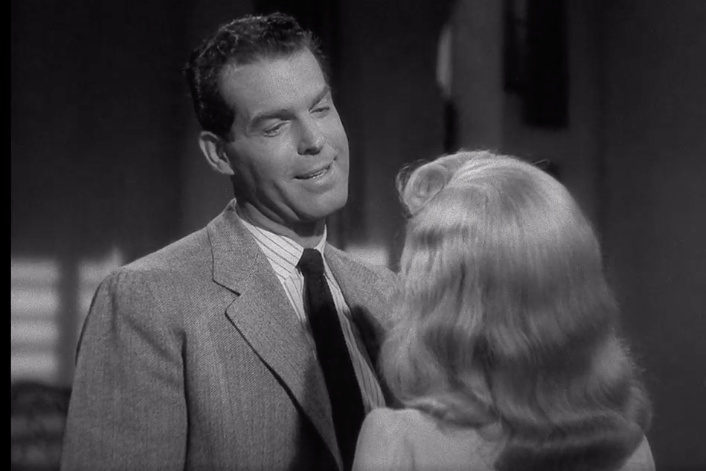
Remember when I said that Walter was a horndog? Well, it’s time to discuss that aspect of his character again. Just at the end of this scene, Walter flirts very strongly with Phyllis, propositioning her through innuendo, and is only dissuaded when she reminds him that she has a husband. Walter’s going against conventional morals here which I feel like even in the late 30’s (when the film is set) would dictate that its not polite to flirt with married people. Porifiro states that noir characters often “live lives untrammeled by moral norms” (88), and I suppose that would be reflected here.
This scene in Double Indemnity encapsulates a lot of Porfirio’s writing on existentialism and would be valuable viewing material from anyone studying existentialism and noir. And if nothing else, the movie’s probably worth the watch simply for the insurance fraud inspiration.
Works Cited
Double Indemnity. Directed by Billy Wilder, performances by Fred MacMurray, Barbara Stanwyck. Paramount Pictures, 1944.
Porfirio, Robert G. No Way Out: Existential Motifs in the Film Noir. 1976.
 Sam's Blog