Be yourself; Everyone else is already taken.
— Oscar Wilde.
This is the first post on my new blog. I’m just getting this new blog going, so stay tuned for more. Subscribe below to get notified when I post new updates.
Be yourself; Everyone else is already taken.
— Oscar Wilde.
This is the first post on my new blog. I’m just getting this new blog going, so stay tuned for more. Subscribe below to get notified when I post new updates.
Here’s the link to my website!! I might have to update this with a new link if it doesn’t update automatically. Thanks for a great semester and good luck on your projects!
Hi! Sorry I’m posting this so late. Here’s a link to the website my project is on.
https://smarsh170.wixsite.com/filmnoirparody
Have I set up the main page? Not yet! But! I have added pages on parody, My Favorite Brunette (a film noir parody film) and A Femme Fatale Fails.
That’s right, I changed ideas. And I meant to ask Brett if I could do that and I forgot. To Brett, I am sorry. I will email you as soon as this is finished. To my classmates, I hope your projects are going well and I welcome any critique. Alright, now let’s get to the New Idea!
Project Title–Laughter in the Dark: Parodies of Film Noir
Brief Point: This project will be a website that features as many examples of Film Noir parodies. The very nature of parodies requires them to pay close attention to their source material in order to insert humor that fits audience expectation. Through the use of techniques like exaggeration, inversion, and trivialization, parodies affirm and negotiate the boundaries of their chosen genre, and this negotiation can show us how parodies affirm certain aspects of Film Noir.
Outline:
I’m honestly still considering my organization. I see two ways of doing this project: organizing it like a database or organizing it like web essay. Here’s what I would do for each.
Organized like a database–in this version of my project, I would analyze each example of Film Noir parody individually and point out specifically what parody techniques the text is using and how those techniques are both critiquing and affirming Noir themes and techniques. On the main site I would give a brief history of parody and parody techniques, and from there offer lists based on the type of media (film, comedy sketch, radio show), the main Noir topic it critiques (gender roles in Noir, the corrupting city, existential hopelessness, etc). I’d obviously have to come up with more lists depending on how many more Noir parodies I can suss out.
Organized like a web essay–in this version, I would need to do a lot more intentional sequencing. I think this is something like how I could structure it:
Annotated Bibliography:
Cohen, J. L. “The Art of Parody: Imitation With a Twist.” The Artifice, the-artifice.com/the-art-of-parody/. Accessed 9 Dec. 2015.
“Comedy and Genre Boundaries.” Laughing Matters: Understanding Film, Television and Radio Comedy, by John Mundy and Glyn White, 1st ed., Manchester University Press, Manchester, 2012, pp. 130–148. JSTOR, http://www.jstor.org/stable/j.ctt1vwmft8.11.
Dentith, Simon. “Chapter 1: APPROACHES TO PARODY.” Parody, Taylor & Francis Ltd / Books, 2000, pp. 1–38. EBSCOhost, search.ebscohost.com/login.aspx?direct=true&db=lfh&AN=17445199&site=ehost-live&scope=site.
“For some writers, parody serves a
normative critical function, indeed, it acts to do so when the more
modern forms of criticism such as the literary essay are absent,
and its function is to make explicit the absurdities of current poetic
fashions. On the other hand, it has been claimed, especially by the
group of critics known as Russian Formalists, that parody can
contribute to the evolution of literary style” (33).
Keogh, Tom. “”Kiss Kiss Bang Bang:” Noir Parody is Dark Dark Laugh Laugh.” Seattle Times, 28 Oct. 2005, www.seattletimes.com/entertainment/movies/kiss-kiss-bang-bang-noir-parody-is-dark-dark-laugh-laugh/.
Mazzillo, Amanda. “The Beginner’s Guide: Parody.” Film Inquiry, 5 May 2017, www.filminquiry.com/beginners-guide-parody/.
I’ll add to these texts as I continue research. Here are the citations for the examples of parody Noir I’ll be using.
64 Bits. “64 Bits – Detective Pikachu Noir – (Animated Parody).” YouTube, 17 Jan. 2020, http://www.youtube.com/watch?v=hpcx2W0Bk6g&t=3s.
Garrison Keillor, producer. A Prarie Home Companion. NPR, 1974.
Dead Men Don’t Wear Plaid. Directed by Carl Reiner, performances by Steve Martin, Rachel Ward. Universal Pictures, 1982
The Escapist. “There Will Be Brawl: Episode One.” Youtube, 19 July 2011, http://www.youtube.com/watch?v=pWXX60o1Ezs&t=57s.
Ianniciello, Adrienne. “A Femme Fatale Fails.” YouTube, Characters Wanted, 10 May 2019, http://www.youtube.com/watch?v=Yk9rPACMKZA.
Kiss Kiss Bang Bang. Directed by Shane Black, Warner Bros. Pictures, 2005.
Who Framed Rodger Rabbit. Directed by Robert Zemeckis, Buena Vista Pictures, 1988.
I’m linking the google doc to my Storyboard here!
https://docs.google.com/document/d/1Ejc9VSSbQD8dymZRnLCiSLPaFTHwxUwk64-V5dlxaQg/edit?usp=sharing
Google Docs was the easiest medium for me to do this in, so I hope this link is adequate. If not, I can definitely try and transfer it over to WordPress!
Additionally, here’s the file of my script voiceover:
I uploaded it to Soundcloud so I would be able to link it on this blog. Thanks for reading and listening!
For my project, I want to continue to expand on the topics of Film Noir and Video Games that I discussed in my Video Essay script draft. One thing I didn’t really get to examine was the storytelling aspects games afford the Noir “genre.” I think for my thesis I would want to focus in on the idea of an interactive story with a permeable main character and how these aspects of game design reflect an evolution of Noir sensibilities.

However, this doesn’t seem like nearly enough meat for a 16-20 page essay. I’m thinking that I could create a twine game that features a Noir protagonist with a shifting personality to display this idea of an unstable main character whose morality is defined by the player as a hallmark of a Video Game Noir.
Some thoughts and problems:
Here begins my voiceover script!
Film Noir developed as a movement in the 1940’s. Since its inception, Noir films have been a major influence on other pieces of media including tv series (clip of Fargo), comic books (Edgy batman comic image), and even musical albums (Lana Del Rey music video clip). However, up until recently I hadn’t ever really considered the residual effects Film Noir might have on video games. While scrolling through the Steam store I stumbled across a game tagged “Noir” amongst other features like “RPG” and “Strategy.” I was intrigued and wanted to learn why it had been labelled this way, but the Steam store doesn’t over any explanation or flavor text for their various tags. They’re usually just short tidbits that give you an overview of the type gameplay, story elements, or art style a video game contains. So, what has Steam decided classifies a game as “Noir?” Is it something in the story, the aesthetics, or even the gameplay? I set out to find the answer and decided to choose some of the top selling games under the Steam tag—along with a game suggested by my classmates—to analyze in my search.
But before I get to the games, it might help to talk a little bit more about Noir and why it likely can’t be tacked onto a game without creating a bit of confusion. Films Noir, the influences on these games, are a group of texts that lack a classifying feature. As Professor James Naremore argues, there’s no “one thing” that a classifies a film as a Film Noir and there’s no one thing that all Noir films have in common (12). This makes Noir a murky category for definition, especially within an unexplained Steam tag. However, there are some elements that scholars argue are central to film noir that may help in pin down what Steam is classifying as “Noir.” These include narrative themes like Existentialism and Despair, Fatal Women, and Corruption in the City. They also include aesthetic choices in lighting and a use of expressionist images. These are the main aspects of Noir that I’ll be looking at when determining what elements of Noir these video games are channeling. Now, onto the games!
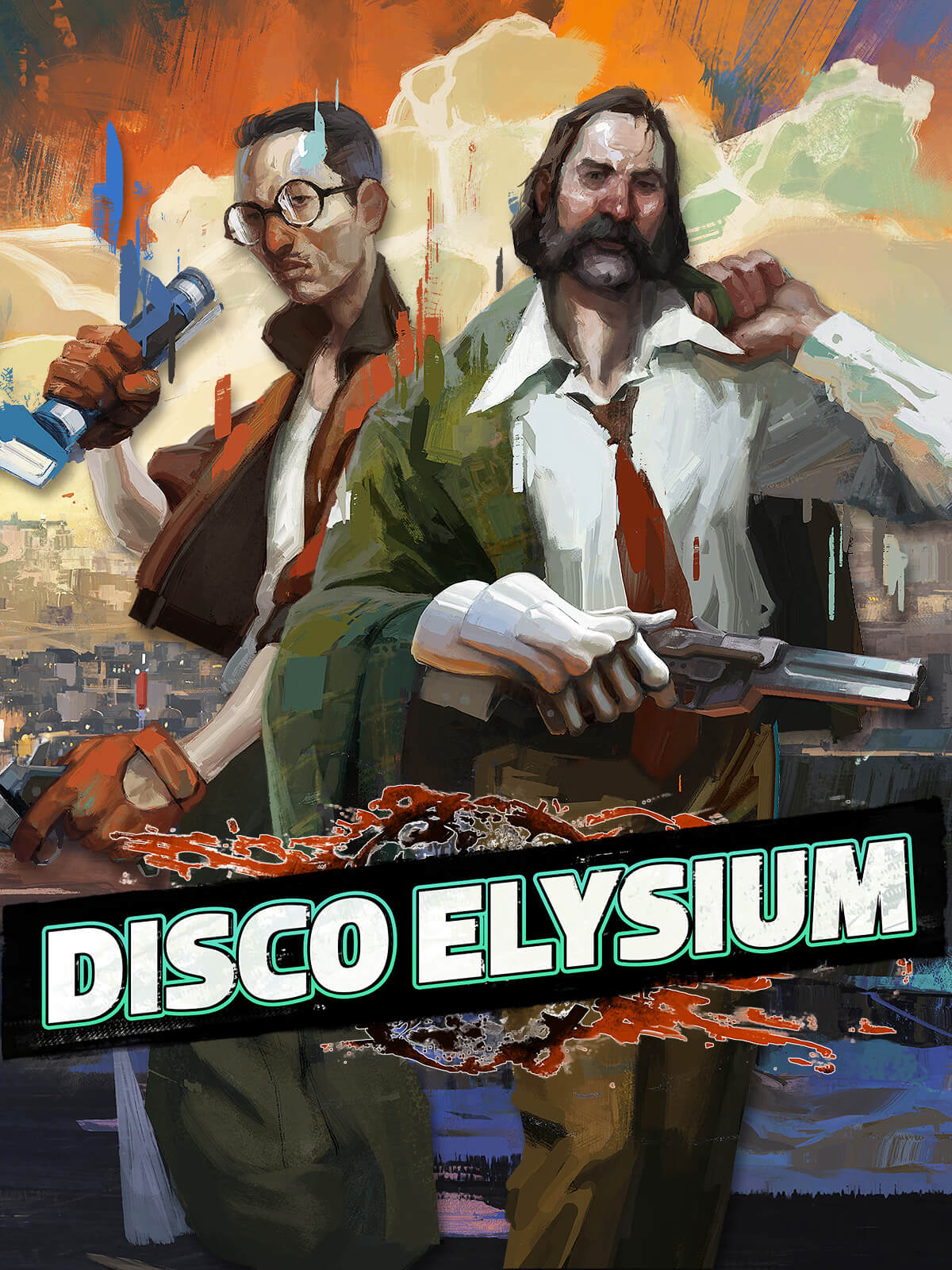
First on the highest selling list is Disco Elysium, a game produced by developers ZA/UM. In Disco Elysium you play as a detective tasked with solving a string of gruesome murders in the fictional city of Revachol. Notice I didn’t include the detective’s name. That’s because upon immediately loading in, the game reveals that your character is an amnesiac who can’t remember what his name, and your choices will determine what he calls himself for the rest of the game. This moment is just one display of this abundance of seemingly random choices that will impact your personal story. Because your character is literally a blank slate, your choices and interactions with other characters will determine who he becomes. For example, Laura Dale at Polygon managed to have her character believe he was actually a rock star in hiding. She writes about this, stating,
Despite all signs to the contrary, he decided that if he went out and sang for a crowd, they would all be in awe of his talent and he would be whisked off to a well-deserved life of luxury. After going on a multipart quest to find a tape with a ballad on it, practice it alone in my room, and convince a man at the bar to let me sing it at karaoke night, I fail a roll to keep my nerve.
My reward is watching my character spend nearly three full minutes warbling that ballad out of tune. I wasn’t upset; I laughed and smiled, soaking in my failure. I was a mess, but I was owning it (Dale).
The sheer amount of choice this game displays quickly reveals that there are many ways to play your character in terms of their morality. They can be an honest gumshoe trying to crack this case for the good of all, a morally grey opportunist who’s only invested for the thrills, or a vindictive bully who seeks to belittle and control others. This variance in character aligns greatly with existentialist theory, one of the main themes of noir. Robert G. Porfirio describes existentialist theory as placing an “emphasis on man’s contingency in a world where there are no transcendental moral values or absolutes, a world devoid of any meaning but the one he creates himself” (Porfirio 81). This idea of man created meaning is displayed extremely prominently in Disco Elysium in regard to the amnesiac hero figuring out his own character and moralityjustas it is in Films Noir such as Somewhere In The Night. Somewhere In the Night is a Noir Film that follows an amnesiac who returns home from WWII only to get sucked into a murder mystery as he attempts to rediscover his identity. The influence of Film Noir on this game is obvious in its link to themes of existentialism and grey areas of morality. As for a game that links directly to noir through aesthetics, both in terms of lighting and expressionist images, we need look no further than Telltale’s The Wolf Among Us.
The Wolf Among Us was recommended to me with great praise from a few of my classmates. In my research for this video, I got the chance to see where that praise was coming from—and I very much agree with it. The game’s story takes place in a world where fairy tale characters live among us disguised in glamours that make them appear human. These characters are known as “Fables” and make up their own society as they eke out a living in a crushing, corrupt urban environment of Fabletown. The player takes control of Bigby Wolf, the town’s sheriff, as he works with local bureaucrat Snow White to investigate a woman’s murder and free the Fables from the hooks of the infamous crime boss The Crooked Man. The way the characters are lit in this game is a love letter to the Film Noir style of low-key lighting. Authors Place and Peterson describe this style of lighting as when “the ratio of key to fill light is great, creating areas of high contrast and rich, dark shadows” (66). This type of dramatic lighting is seen constantly in how the characters are framed. Even during scenes that take place in the day, characters will trail inky black shadows behind and their faces will be lined with dramatic shadow. This type of lighting reveals how Film Noir stands to influence video games through aesthetics.
However, both Disco Elsyium and The Wolf Among are games on the noir tag that could be argued to contain influences of both noir themes and aesthetics. The game also contains titles like Tangle Tower, a cheery ride through a murder investigation bathed in cartoon graphics and pastels. The aesthetics here aren’t noir, but the themes of the story seem to be. Then there are games like The Shrouded Isle, a political simulator that follows the player’s crazed machinations as a deranged cult leader through an area map shrouded in darkness and sharply defined characters. The themes of Film Noir are necessarily represented here while the noir aesthetics are present. Because of this, I would have to conclude that the games sorted under “Noir” on steam likely contain influence of the themes or the aesthetics of film noir. If you’re looking for an excellent noir game to pick up and brood through, I’d recommend Disco Elysium or The Wolf Among Us. They’re amazing games that truly capture the best of how video games have responded to Film Noir’s influence on other forms of media.
Annotated Bibliography
Dale, Laura. “Disco Elysium Review: Become a Hot Mess in a Ridiculous Adventure.” Polygon, 5 Nov. 2019, http://www.polygon.com/reviews/2019/11/5/20948146/disco-elysium-review-pc.
Naremore, James. “The History of An Idea.” More Than Night: Film Noir in Its Contexts, U of California P, 1998.
Place, Janey, and Lowell Peterson. “Some visual motifs of Film Noir.” Film Noir Reader, edited by Alain Silver and James Ursini, Hal Leonard Corporation, 1996, pp. 65-75.
Porfirio, Robert. “No Way Out: Existential Motifs in Film Noir.” The Philosophy of Film Noir, UP of Kentucky, 2007.
Somewhere In The Night. Directed by Joseph L. Mankiewicz, 20th Century Fox, 1946.
For my video essay, I would like to conduct an investigation in the noir tag applied to video games in the online Steam store. I’d like to compare the elements within these video games such as aesthetics, narrative devices, narratives themes, and cinematography (if applicable??) to popular films noir and neo-noir films to see what pieces of these genres are being recognized as “noir” in these video games.

Research question(s): What does the noir tag suggests about the video games its applied to, and how does it relate to film noir and neo noir? What elements of film and neo noir are present in video games today?
Subjects/Topics: I want to use my project to discuss how aspects of film noir translate into a gaming medium. I’d also like to learn what Steam as a platform considers key to the “noir” experience. To do this, I’m going to have to pull from a variety of noir characteristics including themes (existentialism, fatal women, the city and corruption) and formal elements. However, I likely won’t be analyzing every single one of these aspects of noir. This leads into my next point on…
…What texts I will use in my project?
: From that given outline it might seem like I’m going incredibly broad in scope. To keep my scope a bit more manageable, my plan is to analyze a few of the top selling/most highly rated games in the noir tag (Disco Elysium, Empire of Sin, and The Journey Down: Chapter Two are currently at the top). In my analysis of these games I’ll pick out key ways in which they fit with the definition of film noir/neo noir and key ways they do not. What this means is that for the key aspect of noir I pick out, I will reference the corresponding text. For example, I know Disco Elysium is a game rooted in themes of existentialism, so I will be using the Porfirio for reference. Also, regardless of what texts I do, I will probably be referencing the Peter Fenzel article “L.A. Noire and the Video Game Value of Work” as it delves into both noir and video games. Finally, that brings me to…
…What films will I use in my project?:
Immediately I know I’ll be referencing The Maltese Falcon in comparison to Disco Elysium as both deal with themes of existentialism. As I investigate the other highly rated games, I’ll try and pair a corresponding film to a game based on their similarities in themes and/or aesthetics. I might also pick a film to define as a “classic” noir film and compare all the games to that as a way to streamline the project.
And that’s it! Do you have any tips for me that might improve on my project or help me out? Have you played any of the games below or know of a classically noir game that I should be aware of? Let me know!


Key Largo tells the story of Frank McCloud, a pragmatic army veteran who is taken hostage inside the Hotel Largo by a power criminal and his henchmen. Unable to escape due to a catastrophic hurricane surging just outside the hotel’s doors, Frank and the other hostages attempt to stay alive under the oppressive thumb of the head criminal Johnny Rocco. The film deals with themes of honor, pride, and corruption, and just so happens to be one of my mom’s absolute favorite movies. Consequently its a film near and dear to my heart. When given the option to choose a noir to right about, I knew what I would choose.
Choosing a scene to analyze was a bit tougher. I decided on a scene that I think exemplifies some of the nontraditional formal elements discussed in Place & Peterson’s chapter–Particularly in the way noir lights female characters and the intended claustrophobia of noir mis-en-scene.
The scene begins at around minute 56 (56:12) when Johnny forces his former moll Gaye Dawn to sing one of her old songs in order to have a drink from the bar. For a bit of background on Gaye’s character, Johnny made her into a singer while simultaneously introducing her to alcoholism. Eventually he got bored of Gaye and dumped her, and her addiction eventually destroyed her career. It’s been eight years since they’ve seen each other, and Johnny’s tricked her into showing up to meet him at the Hotel Largo. Throughout the film it’s made clear that Gaye is a hostage and still under Johnny’s control as she’s physically assaulted, locked in a room against her will, and denied any request for alcohol (of which she makes several). This is why Gaye is so desperate for a drink and attempts to sing despite the emotion that infects her performance.
The way Claire Trevor portrays Gaye in this scene does so much to communicate the complexity and tragedy of this humiliating moment. However, I think there are subtle ways the cinematography works to heighten the emotional impact of the this scene while showcasing the iconic formal elements of noir.
First, the lighting. The low-key lighting in this scene showcases the nontraditional way women were lit in noir films. When talking about low-key lighting, Place & Peterson write, “Noir lighting is ‘low-key.’ The ratio of key light to fill light is great, creating areas of hight contrast and rich black, shadows” (66). As the authors describe, the low level amount of light coming from the fill light allows for more shadowy, sharp images. In regards to how this lighting style relates to women in noir, “[the leading actress] close-ups are traditionally diffused…in order to show the actress to her best advantage. Far removed from the feeling of softness and vulnerability created by those techniques, the noir heroines were shot in tough, unromantic close-ups of direct, undiffused light…” (Place & Peterson 66). In this seen we see an example of the this tough, unromantic lighting.
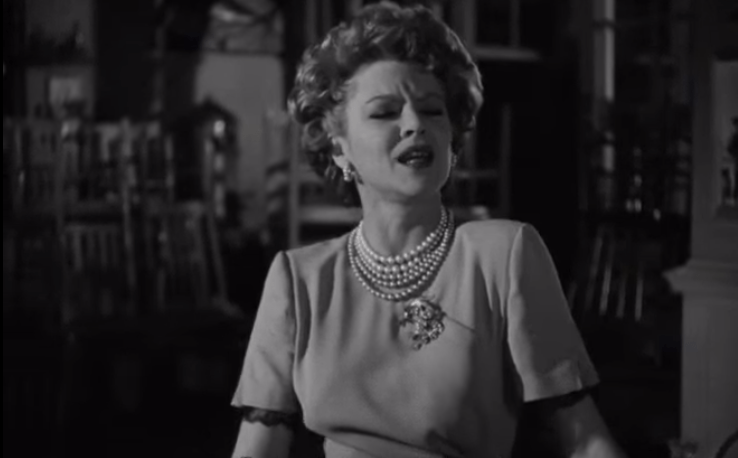
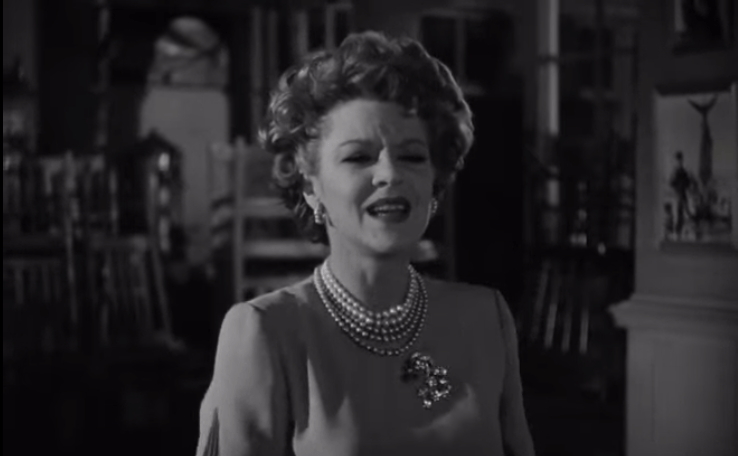
On Gaye’s face we can see a direct example of low-key lighting. The amount of light from fill light is just enough to illuminate the shaded side of her face but dark enough of leave half of it in shadow. However, in Key Largo there exist more defined images of low key lighting featuring bright pops of highlight and deep, dark shadows. What is special about the lighting in this seen is the way low-key lighting is used to frame Gaye in a nonromantic way. While traditional film lighting would fill out the lighting on her face to leave her glowing, flawless, and angelic, the lighting here serves to highlight the lines on her face. Faint as they may be, the lighting helps us to see the furrows in her brow and the smile lines around her mouth. While wrinkles in skin don’t necessarily eliminate a sense of romance or beauty, these features are literally what gauzy, high-key lighting would seek to smooth out in order to create a sense of romantic beauty. Showing them highlights not only Gaye’s age, but also the raw emotion that’s flowing through this scene. Along with noir lighting techniques, this scene also employs use of noir mise-en-scene to play with the idea of claustrophobia.
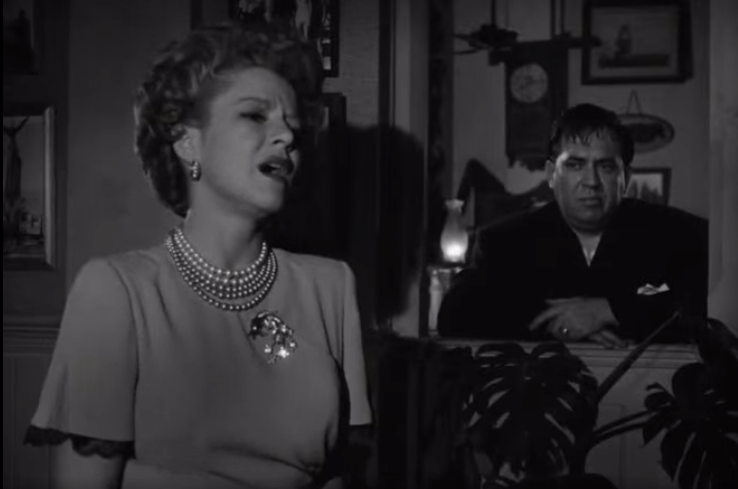
Place & Peterson write that overall, Noir mise-en-scene is meant to “unsettle, jar, and disorient the viewer in composition with the disorientation felt by the noir heroes” (68). One way this occurs, the authors argue, is through claustrophobic framing devices like doors and windows (Place & Peterson 68). While the hero Frank McCloud might not explicitly be represented in the feeling of this scene, I’d argue that this scene still creates a feeling of claustrophobia through its use of a window as a framing device.
In the image above, one of Johnny’s goons stares at Gaye through a window into another room. Not only is a window highlighted in this scene but it’s a blocked window barred by an intimidating, dangerous man. The cuts to that image serve to remind the viewer that for Gaye and the rest of the sympathetic characters, there is no way out. This interpretation makes a lot of sense when paired with author Phillip Furia’s interpretation of the scene. In an NPR interview Furia states, “So she starts singing ‘Moanin’ Low,’ and it’s a wonderful song about a woman who’s trapped in a relationship with a very cruel man. And as she’s singing it, performing the song, you see her realize that that’s exactly her real life situation, that she’s trapped in a relationship with Edward G. Robinson. And that realization has her slowly break down, and her voice falters and she sings off key” (Furia). If this scene is about Gaye’s realization of how trapped she really is, then the use of a claustrophobic framing device makes all the more sense.
Some closing statements about this film that don’t necessarily fit in my scene analysis:
Works Cited
Furia, Phillip. “When Hollywood Had a Song in its Heart.” Interview by Terry Gross. NPR, http://www.npr.org/transcripts/125514785.
Key Largo. Directed by John Huston, Warner Bros, 1948.
Place, Janey, and Lowell Peterson. Film Noir Reader. Edited by Alain Silver and James Ursini, Hal Leonard Corporation, 1996.
When debating which noir theme and which scene from The Asphalt Jungle I would analyze, a standout emerged for each. In terms of theme, the theme of corruption and the city seemed central to the story of the asphalt jungle and particularly to Dix’s character. For a scene, the ending scene in which Dix makes it back to his family’s old horse farm with Doll only to drop dead had me hooked. Though this scene doesn’t take place in the city necessarily, I think it works well to display a lot of what Christopher talks about in the chapter “Into the Labyrinth.”
The three main levels of labyrinth Christopher uses to discuss the theme of city and corruption are: the physical labyrinth of the city, the labyrinth as the human condition and machinations, and the labyrinth of the hero’s inner workings. All three are represented in this final ending scene, though I argue that the first and third have a bit of a stronger case.
Let’s begin with the first–The physical labyrinth of the city. Christopher names this plainly as “the actual physical maze of the city: streets, sidewalks, bridges, automobile and subway tunnels, underpasses, docks and piers…it is packed with millions of unique warrens: office buildings, apartment houses, department stores, and tenements…” (17). Obviously we see the maze of the city represented in the film as characters zigzag and slink between locations. I found the city in the asphalt jungle to be defined not only by its shadowy nooks and crannies, but also by its duality and class difference. The most obvious signal of this is the heist scene where the progression of the characters clues the audience into the dual nature of the presented city.
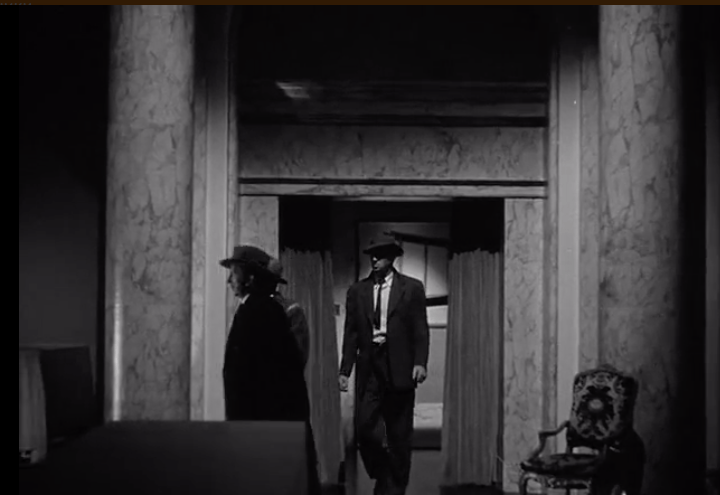
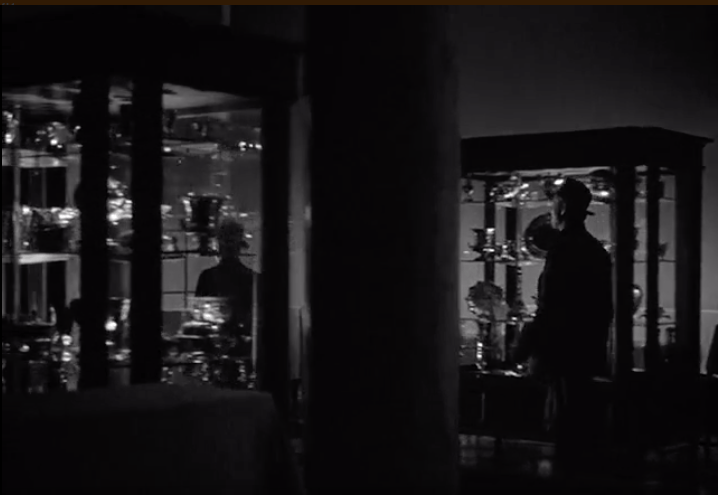
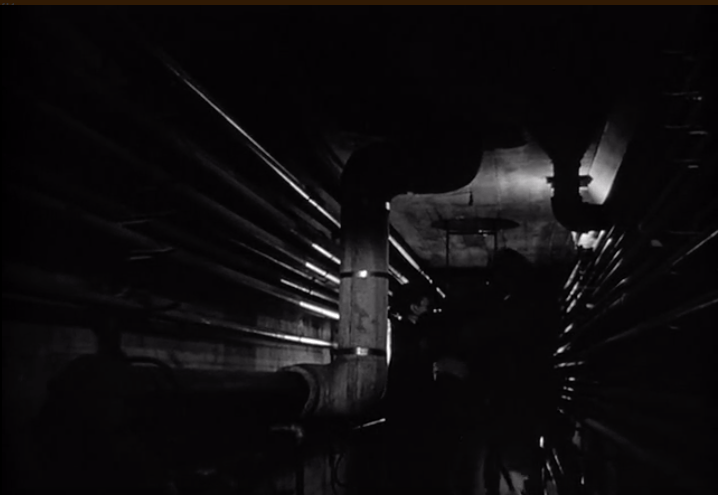
The men enter the bank through the door into an austere and luxurious entrance with marble columns and valuables in glass shelves. They leave by scurrying like rats through a hole in the wall into what looks like a maintenance tunnel. Eventually they pop out of a manhole, making it seem like they’ve come from some sort of grimy sewer. This shows the duality that the city life thrusts upon the character merely in terms of physicality as beautiful backdrops are juxtaposed by harsher, dirtier ones and scenes of wealth are juxtaposed by images of poverty. This same duality, however, doesn’t seem to be represented in the last scene when we as the audience lay our eyes on a rural setting for the first time thus far.
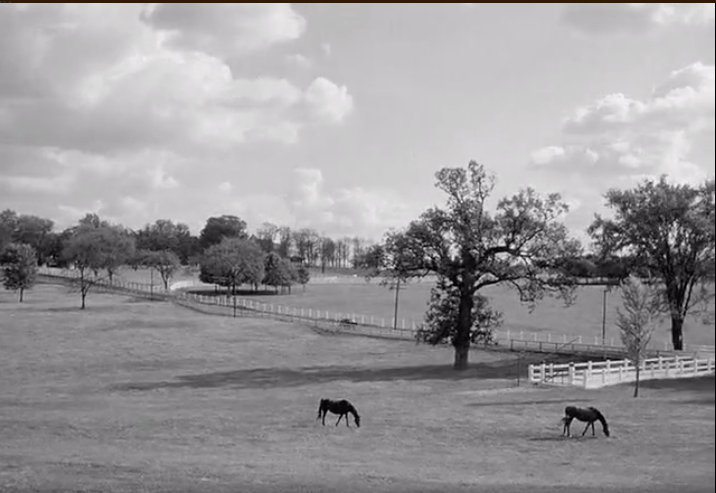
The long shots like the one above display wide open spaces lined with trees. It seems like in this scene, the film is implying a homogeny to the rural setting, as it never changes from this pastoral ideal of wide fields and fences the whole time we see it. This contrasts the two-faced city which is implicitly portrayed as confusing and false in comparison. Additionally, in terms of color the shots in this ending scene are much more washed out than anything we see in the city throughout the film. This can be seen in the picture above, where the dark colored horses stand out from their bright colored field. They are shadows in a world of light, and not flickering lights in a world of shadow.
The second and third tie into the idea of the corrupt city but have more to do with Dix’s character. Christopher defines the second layer of the labyrinth as “the human condition in which the characters intersect and interact in the city” (17). I take this to mean that the second layer is where the characters desires, goals, and actions cross one another and create alliances and conflicts. The characters here are outside the city and the labyrinth, but its effects on their relationship are still distinctly seen.
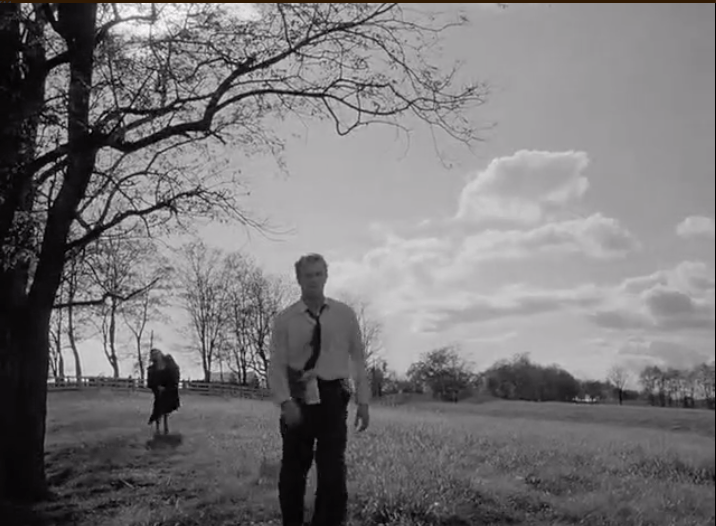
This portion of the scene features Dix limping forward towards the farm while Doll attempts to chase after him. They’re acting out old patterns seen in the film: Doll pursues Dix and Dix flees from Doll. The whole film there’s been a ghostly semblance of a “will they, won’t they” feeling about their relationship, but this seen shows that no, they won’t. Despite having escaped from the city and therefore the labyrinth, the second layer of the labyrinth remains present in terms of their relationship. The city has corrupted whatever could have been between them in its corruption of Dix.
Dix’s journey is finalized here as the exit to the labyrinth and the labyrinth’s third layer shows how trapped Dix’s character really is. Christopher explains the third layer of the labyrinth as “the labyrinth of the hero’s inner workings–mental and physiological–subjected to brutal stresses that mercilessly reveal his flaws” (17). Dix is subjected to brutal stresses that leave him scarred and flawed by the ending scene of the film. This scarring is most obviously seen in how he talks to Doll while in the car.
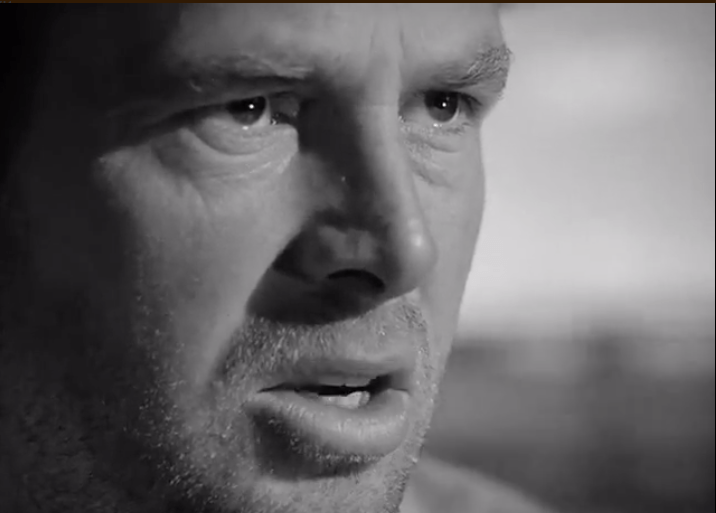
The camera zooms close in his face as he seems to be almost acting out what he said the day he lost everything a bet. He murmurs to Doll, “I said it and I’ll say it again. If pa’ just hangs onto that black colt, everything’s gonna be okay” (1:50:11-23). The stressors from the city that battered Dix have turned his passionate goal into a delusion. Dix himself has been corrupted by the city in terms of his character. Unable to break free of the city’s grip, he dies in the very field he worked so hard to buy back.
I don’t think we’re necessarily meant to demonize Dix. Christopher very clearly states that he sees the noir hero “for what he really is: a victim” (32). Noir heroes are victims of cruel and disorienting cities that fester with corrupting elements waiting to infect the undiscerning gumshoe or femme fatale. And while the police commissioner refers to the city’s criminals as “predatory beasts” (1:48:22), the film gives another animal to clearly identify Dix with. A horse. Not a predator. Just one of the herd.

This week we discussed themes of existentialism and how the inherent meaninglessness of life defined by this school of thought plays out in noir films. According to Robert G. Porfirio, existentialism “is an outlook which begins with a disoriented individual facing a confused world he cannot accept. It places its emphasis on man’s contingency in a world where there are no transcendental values or moral absolutes, a world devoid of any meaning but the one he creates” (81). Porfirio translates this complex definition into the world of film noir by defining and explaining existential film noir motifs such as the non-heroic hero, the man under sentence of death, and the burden and freedom of existential choice. These motifs show up in a scene in Double Indemnity, a salacious noir thriller about murder, lust, and insurance.
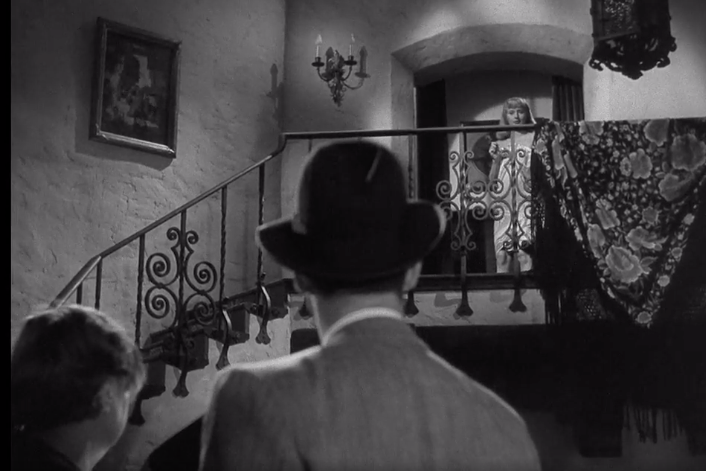
The scene begins when the protagonist Walter Neff enters the home of his client, a Mr. Dietrichson, in an attempt to get him renew his insurance. Instead of Mr. Dietrichson he encounters his wife, Phyllis Dietrichson, emerging from the upstairs hallway glowing from her recent sunbath and the spotlight shining down on her from overhead. It is here we encounter the first of our existential motifs: the unheroic hero.
The way the Phyllis is introduced frames her as powerful and Walter as vulnerable, a staple characteristic of the unheroic noir hero. In the image above, the camera views Phyllis from a low angle and conversely views Walter from a high angle (seen below). In cinematic language, this makes Phyllis come off as in control of the situation and Walter come off as her willing subject–which, of course, he most certainly is.

Walter Neff is a horndog. We know this not only from the way he practically drools over the sight of Phyllis in a towel, but from what he narrates to us as she descends the steps after dressing. Walter’s voice over tell us, “I was thinking about that dame upstairs and the way she had looked at me, and I wanted to see her again, close. Without that silly staircase in-between us” (0:09:25-9:32). The obvious lust Walter displays does more for his character than just show us how…lustful is. While this characteristic wasn’t mentioned in Porfirio’s chapter, I would say it goes towards framing him as a non-heroic or at least non traditional hero.
Another motif present here and immediately prior in the film is the man under sentence of death. The scene right before this features a dying Walter confessing the film’s story over the phone. His narration is what he’s actually saying to someone named Keys. On this narration and the sentence of the death, Porfirio writes, “It is almost as if the narrator takes a perverse pleasure in relating to the events leading up to his current crisis…” (89). He then goes on to cite Double Indemnity as a direct example of this. Walter certainly certainly seems pleased by talking about Phyllis, but he almost seems to love telling his story just for the telling. In his narration he languishes on the details of his surroundings, taking the time to discuss the venetian blinds and red goldfish in the living room. Walter embodies this existential motif thoroughly, just as he does the motif of existential choice.
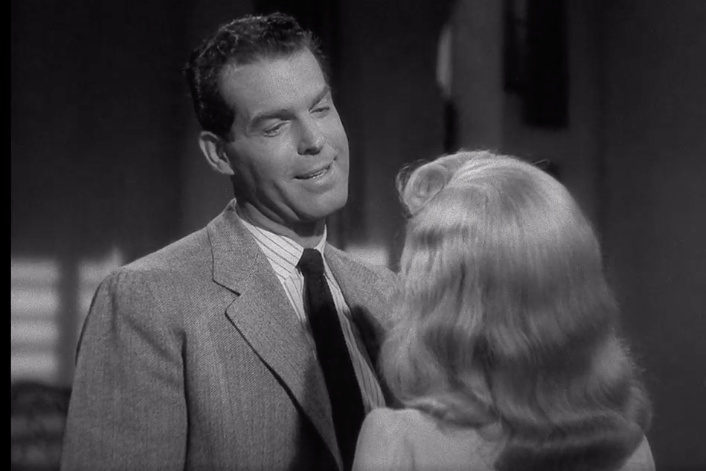
Remember when I said that Walter was a horndog? Well, it’s time to discuss that aspect of his character again. Just at the end of this scene, Walter flirts very strongly with Phyllis, propositioning her through innuendo, and is only dissuaded when she reminds him that she has a husband. Walter’s going against conventional morals here which I feel like even in the late 30’s (when the film is set) would dictate that its not polite to flirt with married people. Porifiro states that noir characters often “live lives untrammeled by moral norms” (88), and I suppose that would be reflected here.
This scene in Double Indemnity encapsulates a lot of Porfirio’s writing on existentialism and would be valuable viewing material from anyone studying existentialism and noir. And if nothing else, the movie’s probably worth the watch simply for the insurance fraud inspiration.
Works Cited
Double Indemnity. Directed by Billy Wilder, performances by Fred MacMurray, Barbara Stanwyck. Paramount Pictures, 1944.
Porfirio, Robert G. No Way Out: Existential Motifs in the Film Noir. 1976.
 Sam's Blog