Key Largo tells the story of Frank McCloud, a pragmatic army veteran who is taken hostage inside the Hotel Largo by a power criminal and his henchmen. Unable to escape due to a catastrophic hurricane surging just outside the hotel’s doors, Frank and the other hostages attempt to stay alive under the oppressive thumb of the head criminal Johnny Rocco. The film deals with themes of honor, pride, and corruption, and just so happens to be one of my mom’s absolute favorite movies. Consequently its a film near and dear to my heart. When given the option to choose a noir to right about, I knew what I would choose.
Choosing a scene to analyze was a bit tougher. I decided on a scene that I think exemplifies some of the nontraditional formal elements discussed in Place & Peterson’s chapter–Particularly in the way noir lights female characters and the intended claustrophobia of noir mis-en-scene.
The scene begins at around minute 56 (56:12) when Johnny forces his former moll Gaye Dawn to sing one of her old songs in order to have a drink from the bar. For a bit of background on Gaye’s character, Johnny made her into a singer while simultaneously introducing her to alcoholism. Eventually he got bored of Gaye and dumped her, and her addiction eventually destroyed her career. It’s been eight years since they’ve seen each other, and Johnny’s tricked her into showing up to meet him at the Hotel Largo. Throughout the film it’s made clear that Gaye is a hostage and still under Johnny’s control as she’s physically assaulted, locked in a room against her will, and denied any request for alcohol (of which she makes several). This is why Gaye is so desperate for a drink and attempts to sing despite the emotion that infects her performance.
The way Claire Trevor portrays Gaye in this scene does so much to communicate the complexity and tragedy of this humiliating moment. However, I think there are subtle ways the cinematography works to heighten the emotional impact of the this scene while showcasing the iconic formal elements of noir.
First, the lighting. The low-key lighting in this scene showcases the nontraditional way women were lit in noir films. When talking about low-key lighting, Place & Peterson write, “Noir lighting is ‘low-key.’ The ratio of key light to fill light is great, creating areas of hight contrast and rich black, shadows” (66). As the authors describe, the low level amount of light coming from the fill light allows for more shadowy, sharp images. In regards to how this lighting style relates to women in noir, “[the leading actress] close-ups are traditionally diffused…in order to show the actress to her best advantage. Far removed from the feeling of softness and vulnerability created by those techniques, the noir heroines were shot in tough, unromantic close-ups of direct, undiffused light…” (Place & Peterson 66). In this seen we see an example of the this tough, unromantic lighting.
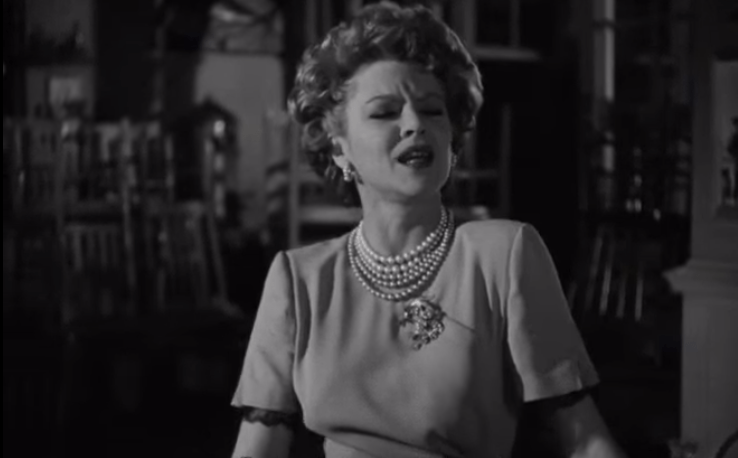
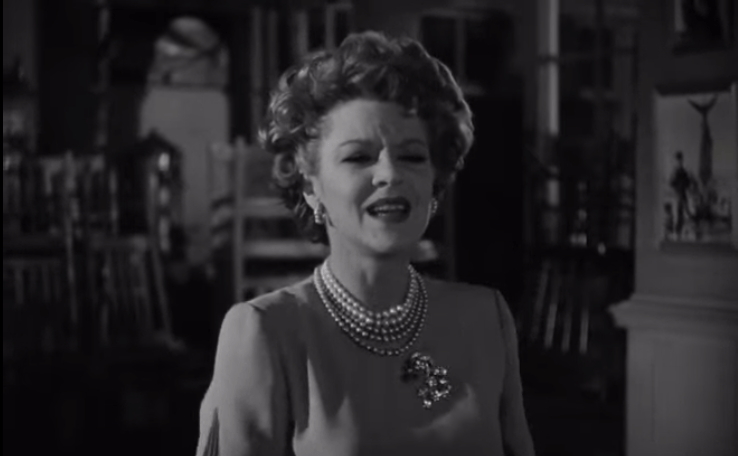
On Gaye’s face we can see a direct example of low-key lighting. The amount of light from fill light is just enough to illuminate the shaded side of her face but dark enough of leave half of it in shadow. However, in Key Largo there exist more defined images of low key lighting featuring bright pops of highlight and deep, dark shadows. What is special about the lighting in this seen is the way low-key lighting is used to frame Gaye in a nonromantic way. While traditional film lighting would fill out the lighting on her face to leave her glowing, flawless, and angelic, the lighting here serves to highlight the lines on her face. Faint as they may be, the lighting helps us to see the furrows in her brow and the smile lines around her mouth. While wrinkles in skin don’t necessarily eliminate a sense of romance or beauty, these features are literally what gauzy, high-key lighting would seek to smooth out in order to create a sense of romantic beauty. Showing them highlights not only Gaye’s age, but also the raw emotion that’s flowing through this scene. Along with noir lighting techniques, this scene also employs use of noir mise-en-scene to play with the idea of claustrophobia.
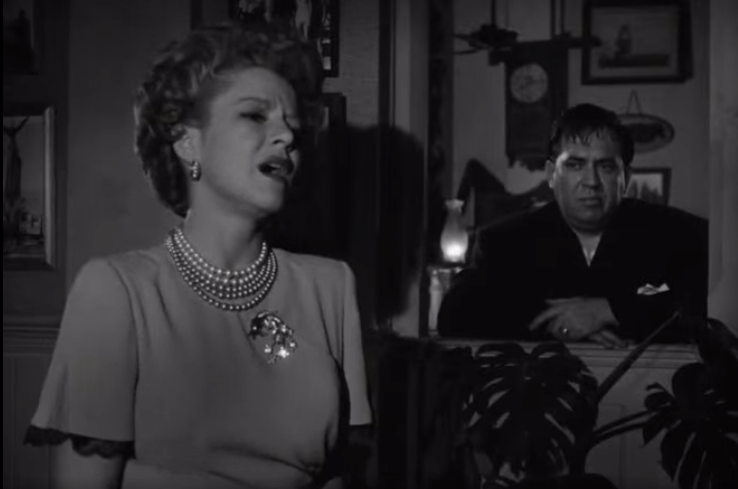
Place & Peterson write that overall, Noir mise-en-scene is meant to “unsettle, jar, and disorient the viewer in composition with the disorientation felt by the noir heroes” (68). One way this occurs, the authors argue, is through claustrophobic framing devices like doors and windows (Place & Peterson 68). While the hero Frank McCloud might not explicitly be represented in the feeling of this scene, I’d argue that this scene still creates a feeling of claustrophobia through its use of a window as a framing device.
In the image above, one of Johnny’s goons stares at Gaye through a window into another room. Not only is a window highlighted in this scene but it’s a blocked window barred by an intimidating, dangerous man. The cuts to that image serve to remind the viewer that for Gaye and the rest of the sympathetic characters, there is no way out. This interpretation makes a lot of sense when paired with author Phillip Furia’s interpretation of the scene. In an NPR interview Furia states, “So she starts singing ‘Moanin’ Low,’ and it’s a wonderful song about a woman who’s trapped in a relationship with a very cruel man. And as she’s singing it, performing the song, you see her realize that that’s exactly her real life situation, that she’s trapped in a relationship with Edward G. Robinson. And that realization has her slowly break down, and her voice falters and she sings off key” (Furia). If this scene is about Gaye’s realization of how trapped she really is, then the use of a claustrophobic framing device makes all the more sense.
Some closing statements about this film that don’t necessarily fit in my scene analysis:
- Gaye’s my favorite character in this movie as she’s the only one besides Humphrey Bogart’s character with a true narrative arc (and his is debatable because he might have been pretending about being a selfish person). Her final act in the movie is tricking Johnny, stealing his gun, and passing it off to Humphrey Bogart’s character so he can defend himself in the final shootout. I still think how she’s portrayed is dated and misogynistic, but her turn from meek and submissive to cunning and heroic is one I didn’t expect an older, alcoholic Femme Fatale to get.
- Apparently the version of Moanin’ Low we hear in the movie is the first take actress Claire Trevor ever did. The director told her not to study the music, so she did it basically off the cuff in order to achieve the character’s desired unsteady and trepidatious sound.
- Trevor won an Academy Award for her performance in this film!
Works Cited
Furia, Phillip. “When Hollywood Had a Song in its Heart.” Interview by Terry Gross. NPR, http://www.npr.org/transcripts/125514785.
Key Largo. Directed by John Huston, Warner Bros, 1948.
Place, Janey, and Lowell Peterson. Film Noir Reader. Edited by Alain Silver and James Ursini, Hal Leonard Corporation, 1996.
 Sam's Blog
One reply on “Scene Analysis 3: Key Largo”
I’m so glad you wrote about this film – not only because of its tribute to your mother, but also because I have never seen it myself, but based on this analysis, I think I need to!
(Interesting to note that TCM, where I watched the scene, categorizes the film as “Crime” as opposed to “Thriller,” another of their genres, or “Noir,” which they don’t offer. There aren’t many films listed under Crime either – only ten – but I wonder how they would categorize most of the films on our course screening list?)
LikeLike